Existing Course Triage & Remediation
Remediating public-facing training content under evolving policy, accessibility,
and operational standards.
Overview
Some courses need incremental updates; others need intervention.
This work focuses on inherited training content that has drifted out of alignment with current policy, operational reality, accessibility expectations, or basic instructional neutrality. In several cases, the courses were already live and publicly accessible, which meant remediation had to happen quickly and carefully without breaking the learner experience or rebuilding from scratch.
In addition to outdated information, the challenge involved accumulated layers of editorial decisions, unsupported connective content, inconsistent sourcing practices, and visual choices that no longer held up under review.
The Challenge
Legacy courses rarely fail in obvious ways. Problems accumulated gradually: unsupported narration, unverifiable sourcing, emotionally loaded framing presented as neutral, and media ecosystems built without consistent provenance standards.
Several remediation efforts also took place during periods of rapid federal policy change and executive-order-driven review requirements, which compressed timelines and increased scrutiny around language, framing, accessibility, and attribution practices.
The courses still had to function. Learners still needed to complete them. SMEs still needed confidence in the material. The work had to happen inside those constraints.
The Process
Each remediation begins with provenance review: identifying what originated from SMEs, what was added during development, and what no longer has defensible sourcing or instructional purpose.
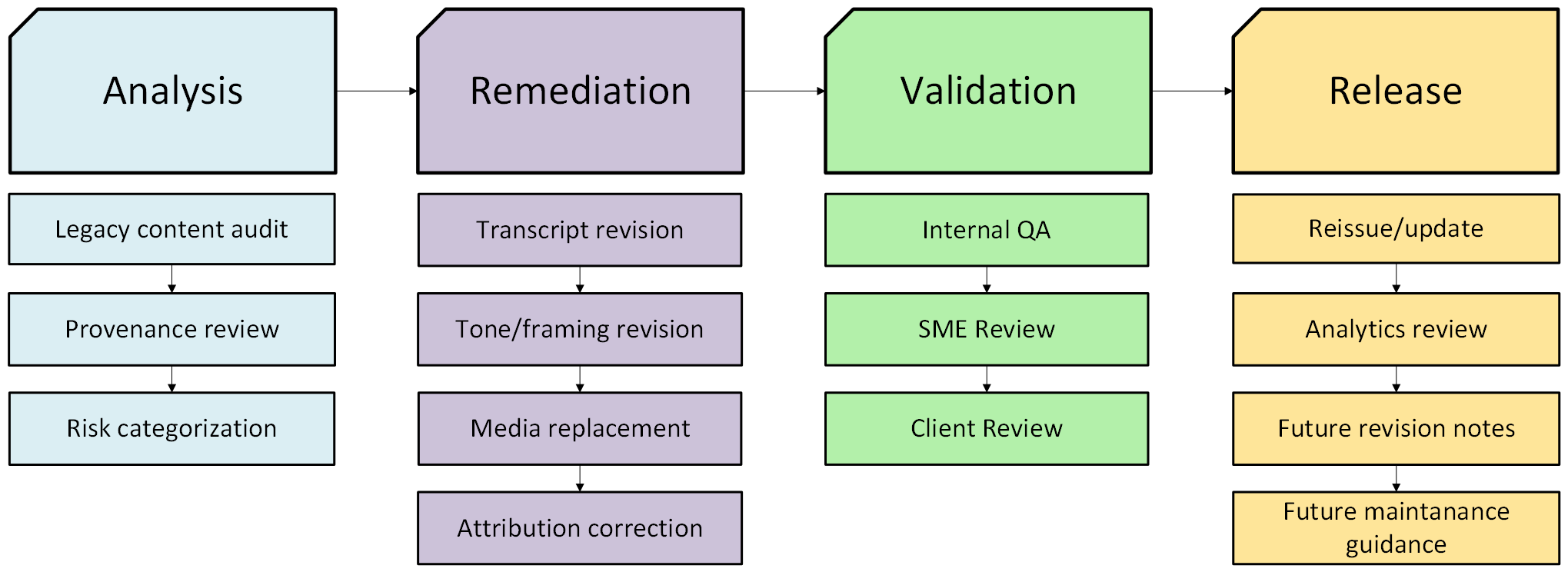
From there, review proceeds in passes rather than all at once: factual accuracy separated from framing and sourcing concerns, with media treated as part of the instructional system rather than decoration.
Representative Engagements
Federal policy alignment
Revised live training content in response to rapidly changing federal guidance and compressed review timelines while maintaining instructional continuity and release schedules.
Full course triage
Completed comprehensive remediation of a public-facing regional course with significant editorial drift across multiple development cycles. Corrected attribution gaps, removed unsupported connective framing, replaced culturally inaccurate imagery, and restored instructional neutrality prior to reissue.
Active-conflict course rebuild
Currently leading the structural overhaul of a course whose instructional framing, media ecosystem, and geopolitical context became materially outdated due to ongoing events. Work includes transcript restructuring, media provenance remediation, accessibility modernization, image replacement strategy, and alignment with updated institutional standards.
What Good Looks Like
A remediated course should feel like it was built correctly in the first place, not as if it were patched together.
That means accurate, attributable content; visuals that support understanding instead of manufacturing emotional tone; sourcing practices that hold up under scrutiny; and instructional framing that informs without asking the learner to adopt a position.
Rather than sanitizing courses into something sterile, the goal is to make them stable: able to survive review, redistribution, future revision cycles, and public visibility without hidden problems sitting underneath the surface.